Evidence and methods
Research checked: 31 August 2026. No project analytics, private trading data, or biological samples were used.
What this document is
An original synthesis of existing attention, neuroscience, and investor-behavior research, plus explicit hypotheses about tradable memes. It is not a validated joint model of those literatures. Evidence about traditional equities, lab tasks, and animals is not automatically evidence about meme-token communities.
Revision 2 adds Michael Levin's cognitive-light-cone framework, temporal depth, cultural diffusion, and a disclosed operator's argument for BUY. These applications are not findings or endorsements from Levin. The same five charts are retained; no speculative success-probability chart was added.
The Hoppa essay linked in the main text is conceptual inspiration. Its claims about objective hype, mandatory exponential decay, and a binary distinction between hype and timelessness are not adopted as established findings.
Minimal claim ledger
| Source | Claim retained | Evidence type and boundary |
|---|---|---|
| Wu & Huberman, 2007 | Digg attention was modeled with stretched-exponential novelty decay. | Historical observational/modeling study; no general numerical meme half-life imported. |
| Leskovec et al., 2009 | Phrase circulation and news cycles have been studied quantitatively. | News/blog phrases, not human neurobiology. |
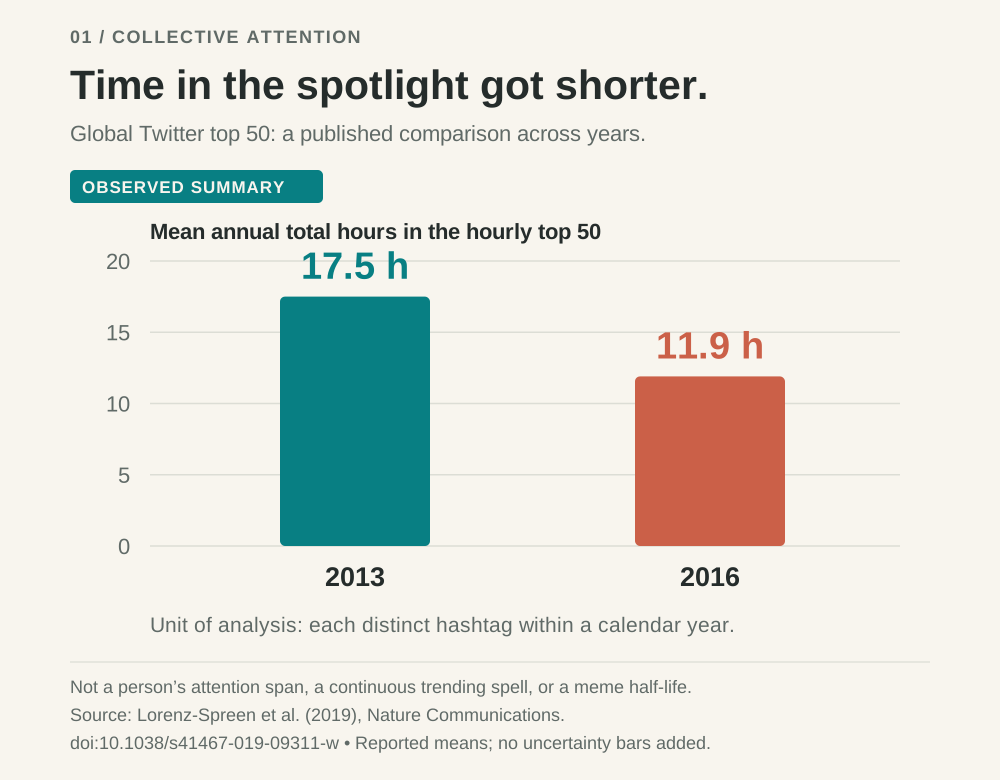
| Lorenz-Spreen et al., 2019 | Chart 01 uses reported means 17.5 and 11.9 hours. | Annual total top-50 occupancy divided by distinct hashtags; 2013 vs 2016, not a continuous spell. The approximately 32% decline uses rounded published means. No current-platform extrapolation. |
| Fiorillo et al., 2003 | Reward expectation and reward uncertainty had distinguishable dopamine-neuron responses. | Macaque recordings during liquid-reward conditioning. Not a claim that uncertainty always increases pleasure or dopamine everywhere. |
| Peciña et al., 2003 | Reward pursuit and positive taste reactions dissociated. | Genetically modified mice, not human traders or a diagnosis of addiction. |
| Cui et al., 2013 | Direct and indirect striatal pathways could coactivate during action initiation. | Mouse circuitry; included to reject the simplistic buy/sell receptor metaphor. |
| Miyazaki et al., 2018 | Effects of serotonin-neuron stimulation on waiting depended on task conditions. | Mouse optogenetics. Does not measure human patience, affiliation, or holding. |
| Coates & Herbert, 2008 | Cortisol covaried with financial uncertainty measures. | 17 male professional traders, eight working days, repeated saliva samples. Small observational study; no individual prediction rule. |
| Kandasamy et al., 2014 and Cueva et al., 2015 | Cortisol manipulation did not have a consistent directional relation to risk across these designs. | Different exposure regimens, populations, and tasks; neither establishes a universal acute/chronic law. |
| Quispe-Torreblanca et al., 2026 | Favorable known outcomes can attract attention without fresh information. | Brokerage observations plus experiments. Daily login is not a count of every check; gains/losses were not universally randomized. No use of the paper's inconsistent relative-effect summaries. |
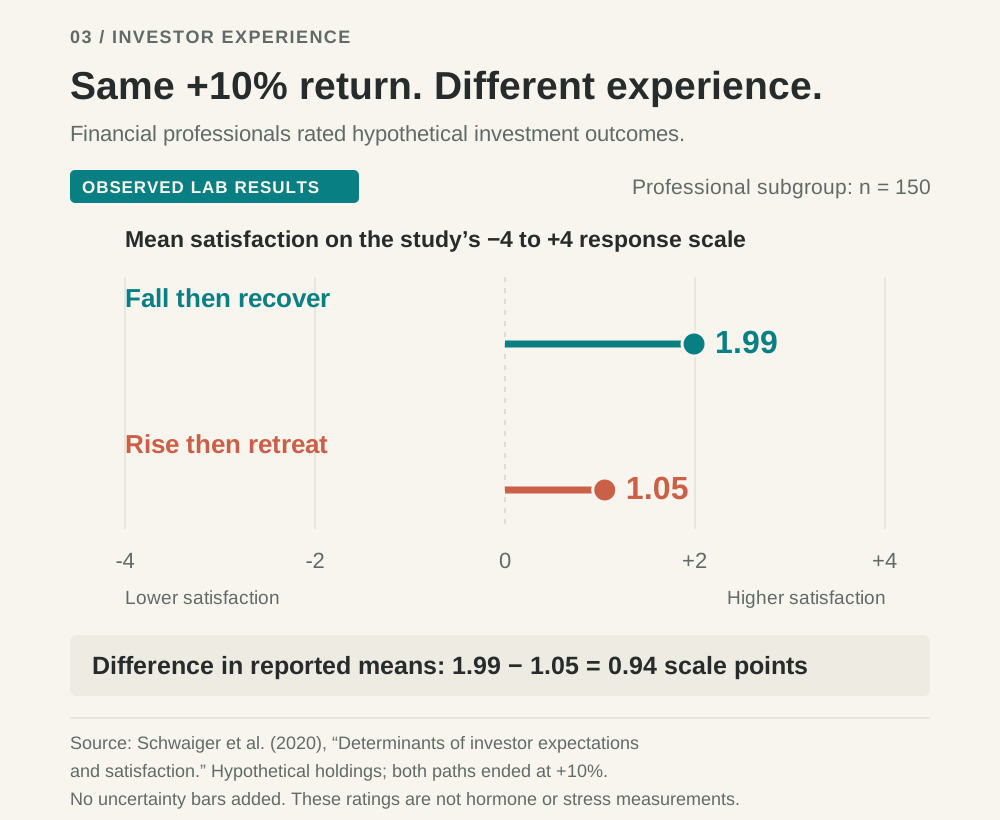
| Schwaiger et al., 2020 | Chart 04 uses 1.99 vs 1.05 mean satisfaction, both at +10% final return. | Table 1, financial professionals N=150, within-subject hypothetical paths, scale −4 to +4. Mean difference 0.94 points; not a ratio of happiness. No invented error bars. |
| Odean, 1998 | Realizing gains was more prevalent than realizing losses in the study's defined opportunity sets. | Historical brokerage records; does not identify the motive for any holding. |
| Strahilevitz et al., 2011 | Repurchases were associated with prices relative to earlier sale prices. | Transaction-based evidence; not a direct measure of regret or post-exit checking. |
Anatomy references in the essay are used for anatomical descriptions, not as evidence for the proposed meme lifecycle.
Revision 2: concept and project ledger
| Source | Claim retained | Boundary |
|---|---|---|
| Levin, 2019 | Cognitive light cone concerns the reach of sensing, modeling, and attempted action. | Theoretical framework, not a numerical meme/community ranking or a physical light cone. |
| Tolchinsky, Levin et al., 2025 | Temporal depth concerns recall and planning. | Clinical theoretical source; no clinical analogy or diagnosis imported. Temporal width is the essay author's loose term, not presented as Levin's exact terminology. |
| Levin & Resnik, 2026 | Collective agency requires behavioral integration for goal pursuit. | Shared attention, token holding, or a distant prediction alone does not establish it. |
| Dogecoin history | Kabosu photograph 2010; Dogecoin launch December 2013. | First-party retrospective establishes chronology, not how much familiarity caused success. No promotional growth or price figures imported. |
| ALS Association, 2019 retrospective | The challenge combined a filmed act, nominations, existing relationships, and wider amplification. | Documented features, not causal effect estimates. |
| Goel et al., 2016 | Popularity and structural virality differ; broadcast and successive sharing can combine. | Historical Twitter study. Reach is not proof of multigenerational independent reproduction. |
| Weng et al., 2013 | Early community distribution helped predict hashtag popularity. | Observational; reinforcement and homophily not fully separated. Not a token-winner model. |
| Shifman, 2013 | Forwarding differs from imitation and remix. | Conceptual research; a participatory format is not a guaranteed growth intervention. |
| Salganik et al., 2006 | Social influence increased inequality and unpredictability in an artificial music market. | Not a meme-token trial; supports caution about forecasting winners from appealing characteristics. |
| Robinhood annual report | The specified purchase restrictions began January 28, 2021. | Printed page 136. No adjacent legal allegation, motive, or audience-reach claim inferred. |
| BUY brand, Witness, thesis | Visual/action grammar, public recollection archive, and explicit independence exist. | Live text checked August 31. Project-owned sources establish their content, not independent demand, community competence, or investment quality. |
| Button Hunt | Public page presents a card-collecting game. | HTTP 200 and HTML inspected August 31; no wallet login, full gameplay audit, player-count claim, or retention inference in this research pass. |
The BUY case is a qualitative, interested thesis about cultural opportunity. It does not estimate a probability of success, compare all competing memes, establish highest odds, or predict token returns. Action comprehension, project attribution, and independent authorship are explicitly separate proposed outcomes. Neither a familiar button nor adoption of generic buy-button imagery proves adoption of this specific project.
Model status and retained figures
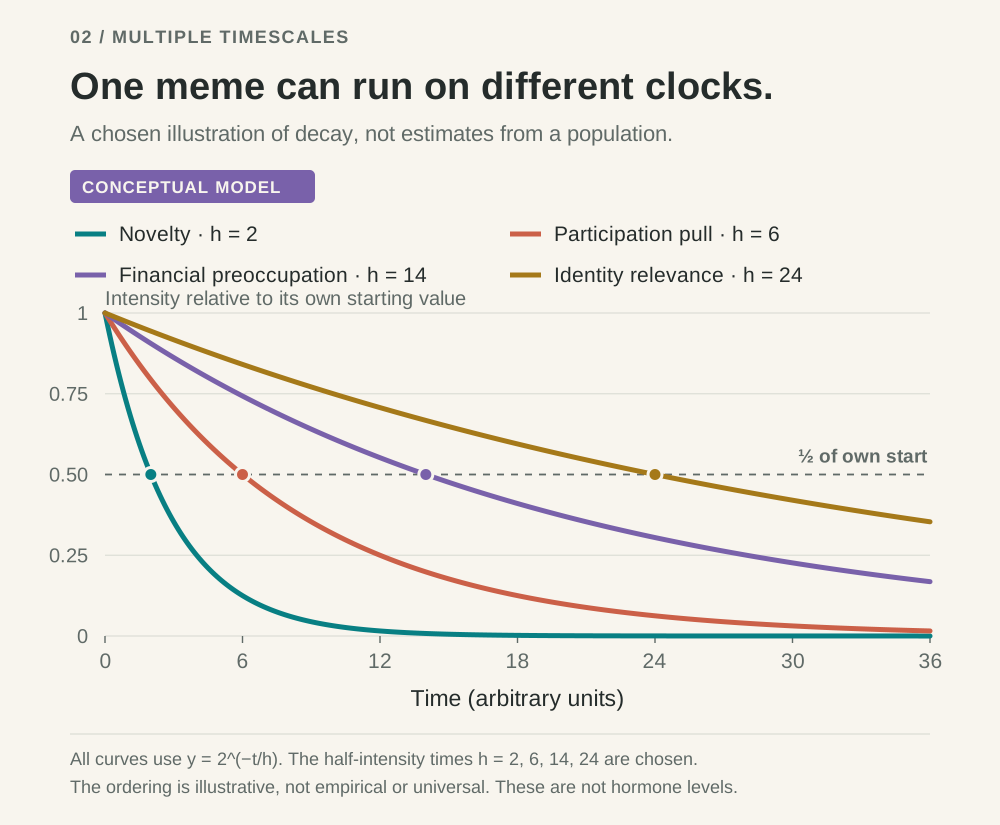
- Chart 02 is four exponential functions with deliberately different chosen half-lives. It shows what that assumption entails, not that those are the correct half-lives or correct ordering.
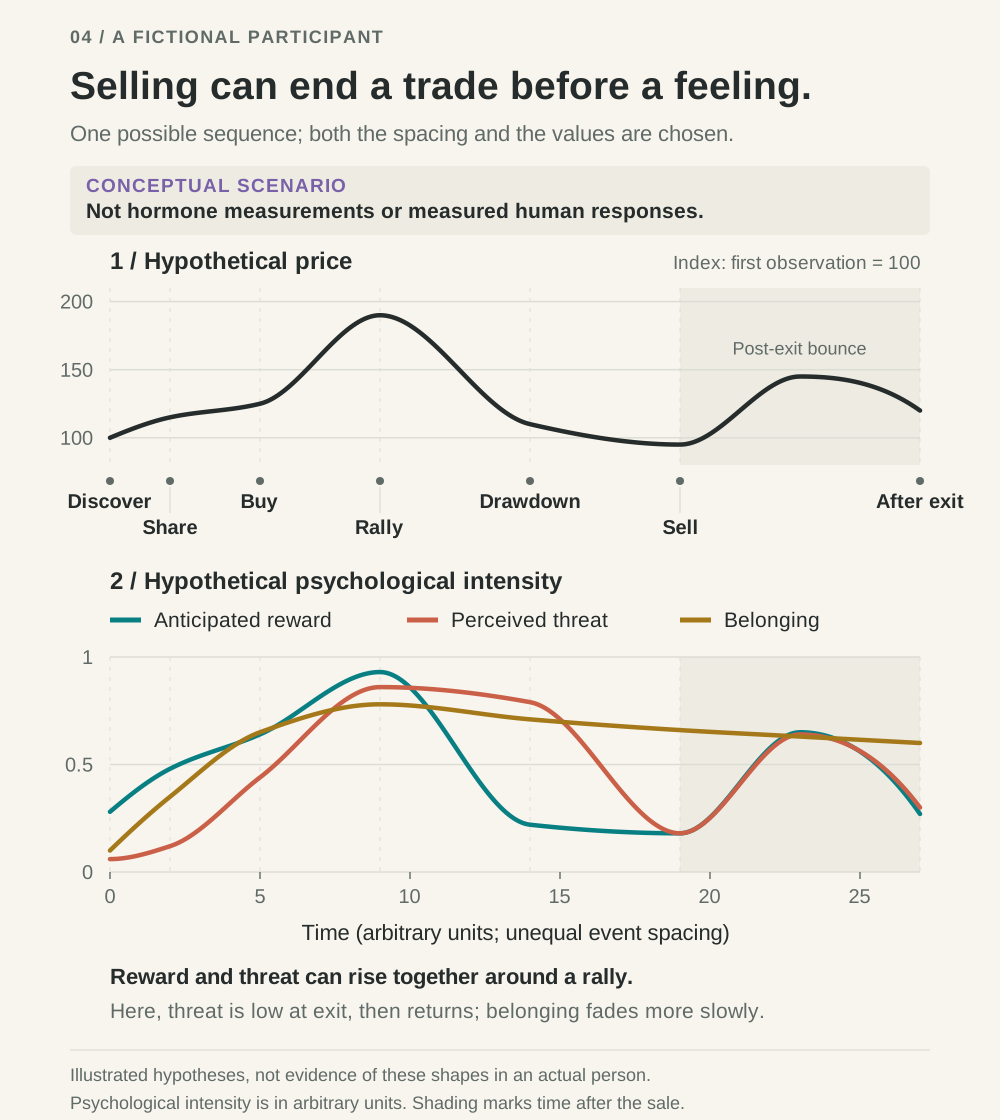
- Chart 03 is a hand-specified scenario. Its reward, threat, and belonging intensities have arbitrary units. It has no fitted parameters, validated physiological lag, prediction interval, or representative participant.
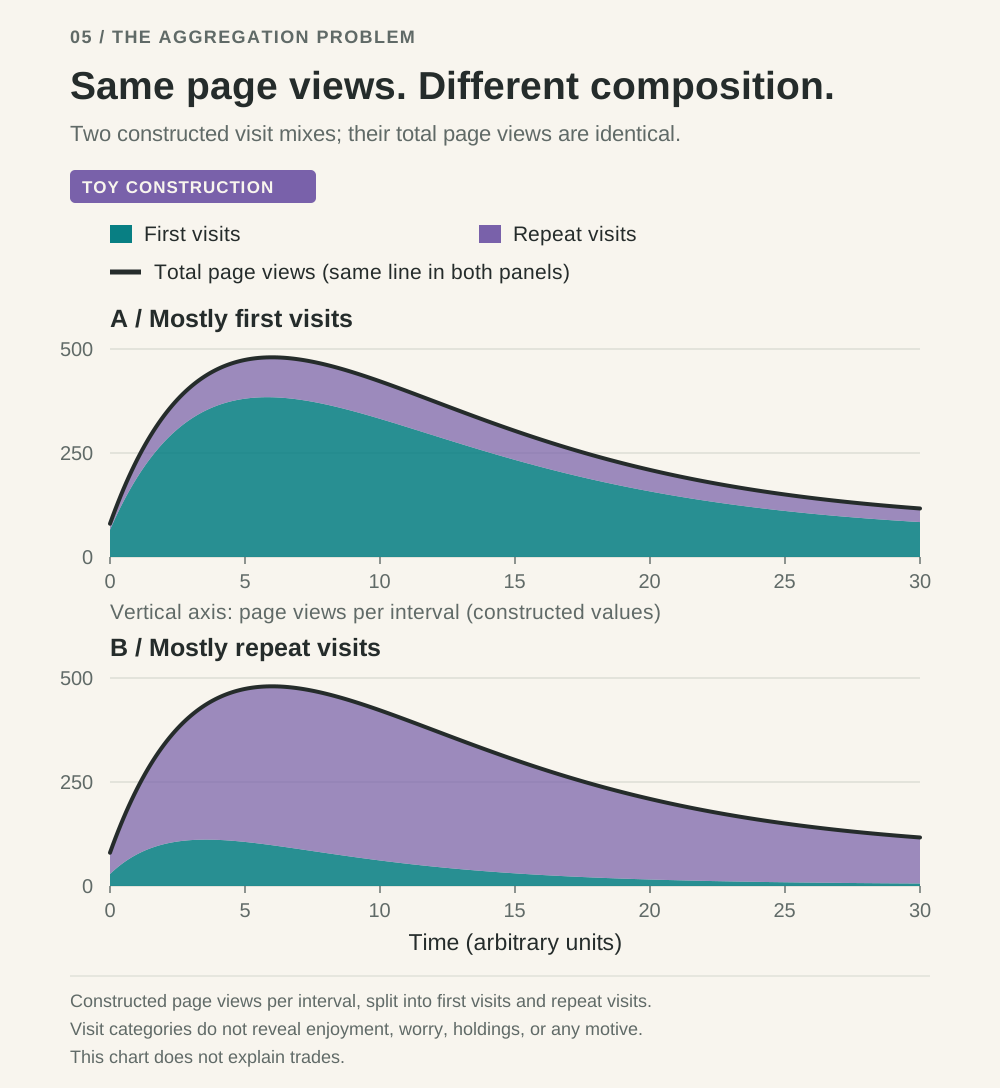
- Chart 05 constructs observational equivalence: first visits and repeat visits to the same page produce identical total page views in two scenarios. The visit categories still do not identify motives. This is not a decomposition of trades or mixed engagement types.
- The +10% expectation example and the $100/$300 drawdown example are arithmetic thought experiments, not measured prediction-error signaling or stress.
For formulae, selected parameters, exact plotted values, and regeneration instructions, see charts/README.md and the generator in that folder.
What better data could and could not establish
An opt-in repeated-measures panel could assess whether motives, subjective states, and behavior change together within people. It should define stage entry and exit, detect partial exits, record relevant market events, distinguish content from portfolio checks, and retain missingness. Identity linkage should be participant-authorized, pseudonymous, minimized, and revocable; never infer or publish social-to-wallet identities without consent.
Useful preregistered outcomes: self-rated amusement; perceived uncertainty and worry; belonging; voluntary checking; content creation; participation after full exit. Separate the probability of returning from the number of checks among those who return. Report platform visibility and recruitment limits. Include non-buying participants and avoid treating inactive wallets as enthusiastic holders.
Fit baseline-adjusted event responses, not a universal decay curve from aggregate price. Compare exponential, stretched-exponential, and flexible alternatives out of sample. A last-observed response above half-level is censored. Ordinal self-ratings do not automatically support ratios or literal experiential half-lives; use a defended measurement model or prespecified response thresholds. Condition post-exit participation comparisons on pre-exit participation and exposure history. New triggers, differing baselines, overlapping cohorts, and changed meanings of an action can make a single half-life misleading. Do not interpret a plateau as infinite durability or a rebound as the original cohort's return.
An exit event study remains observational because people choose when to exit. Hormonal mechanisms require separate ethically designed biological measurement and domain expertise. Engagement, sentiment models, wearables, or prices cannot stand in as neurotransmitter/receptor assays.
Chart files
SVGs retain vector detail. CSVs contain the exact values plotted. The generator creates the figures locally; it makes no market-data or biological measurements.