WHY BUY? / PROJECT THESIS / 8 AUG 2026
THE BUTTON
STAYS ON
The work is not to keep attention on the Button. It is to keep the Button on.
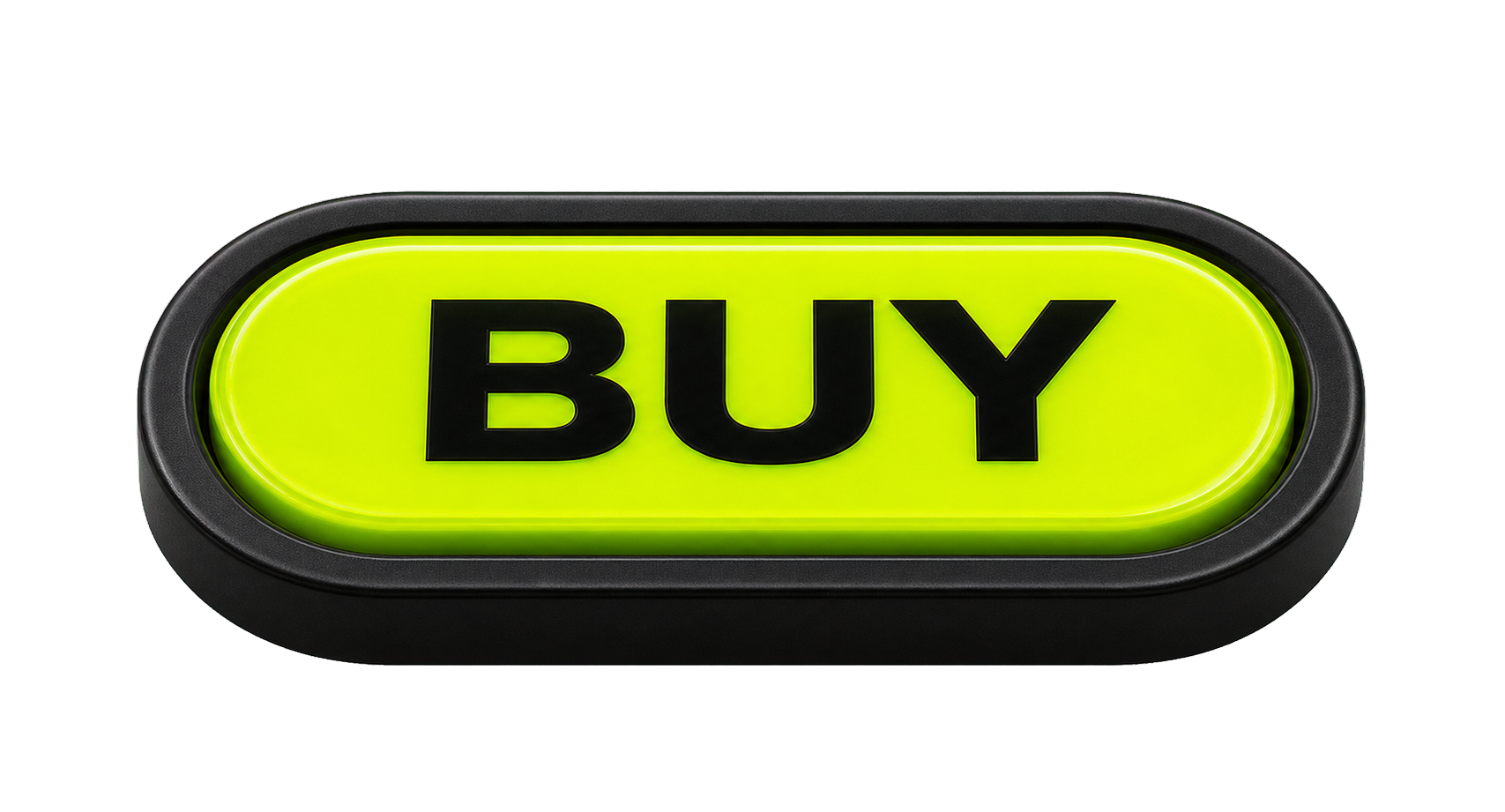
THE BUTTON IS THE PROJECT.
Opening statement
Why are we doing this project?
I am not interested in writing you another slop thesis.
Most token theses are assembled backward. The price moves first. Then someone manufactures a mythology, commissions a thread and explains why the chart was destiny.
$BUY is the opposite.
The story existed before the token. The symbol existed before this project. Millions of people already understood the Button because, for one strange moment in 2021, they understood exactly what it meant for that Button to disappear.
The upside is large: preserve an important piece of internet history, turn it into a living public object and discover what happens when a meme is treated as infrastructure instead of disposable content.
The downside is honest: the market may decide none of this matters.
We are doing it anyway.
THE OBJECT
THE OBJECT
Another memecoin? That is the thesis?
No.
The token is the transport layer. The Button is the project.
Most memecoins begin with a character and attempt to manufacture significance around it. $BUY begins with an action people already know.
A frog is a noun. A cat is a noun. A dog is a noun.
BUY is a verb.
Characters can be replaced. The verb survives.
Every market, broker, exchange and shopping cart eventually reduces itself to the same instruction. After all the research, charts, arguments and risk warnings, someone still has to make a decision.
Someone has to press.
THE OBJECT
Why this Button?
Because this Button has already demonstrated its meaning.
On January 28, 2021, Robinhood customers opened the app and found purchases restricted in a set of securities. The institutional explanation involved volatility, collateral requirements and clearing infrastructure.
The human explanation was simpler:
The Button was off.
That missing interface became the smallest accurate picture of the entire event. It compressed a complicated financial system into one absent possibility.
People did not need a white paper to understand it.
That is rare.
THE OBJECT
But 2021 is over.
The restrictions ended.
The symbol did not.
Internet culture usually processes an event quickly. Something happens. It becomes a meme. The meme is packaged into content, sold into a few attention slots and discarded when the next object arrives.
That is efficient.
It is also how the internet forgets.
$BUY asks a different question: what happens if someone refuses to discard the object? What happens if the joke receives research, software, provenance, witnesses, maintenance and time?
Not because every meme deserves this treatment.
Because this one might.
THE WAGER
THE WAGER
Why BUY?
Let me answer carefully.
Do not buy because someone associated with the project tells you to. Do not buy if you expect a guaranteed return, revenue share, redemption, treasury ownership, control over project assets or an endorsement from Robinhood.
None of those things exists.
$BUY does not represent Robinhood stock. Holders have no claim on the public $HOOD position, creator fees, project revenue or any other treasury asset. The market can fall dramatically or disappear entirely.
The actual thesis is simpler:
- The story existed before the market.
- The symbol is instantly understandable.
- The Button is an action, not another mascot.
- The Button's return on Robinhood Chain creates an unusually coherent second act.
- Each new archive record, proof receipt, artwork, integration and community contribution makes the object more legible.
- Serious stewardship is scarce in a market full of disposable narratives.
If the project becomes culturally useful, the market may eventually decide that usefulness has value.
That last step is not guaranteed.
It is the wager.
You are not being asked to believe that a developer can invent a meme. You are deciding whether an existing piece of cultural memory can acquire a durable life of its own.
The noun can be replaced.
The verb remains.
THE WAGER
So this is still speculation.
Of course.
A liquid token creates a market around the object. Markets are unstable, mimetic and frequently ridiculous.
That does not make them culturally irrelevant.
In 2021, the Button became meaningful precisely because millions of people wanted to perform the same action at the same time. They saw one another wanting it. The obstruction synchronized them.
That is the deeper pattern.
Desire is rarely private once a crowd can see itself desiring. One person presses because another person pressed. One community notices because another community noticed. The market does not merely price the meme; it performs it.
The Button cannot tell you whether that performance is intelligent.
It can reveal that it happened.
THE WAGER
Why put it onchain?
Because an ordinary image can only represent the Button.
An onchain Button can be used.
Every verified buy can become a press. Every press can leave a receipt. Every interval can be preserved. The object can accumulate activity, memory and wear.
The original Button became meaningful because people could not press it.
This Button becomes meaningful because every press can be witnessed.
The chain is the finger.
THE INFRASTRUCTURE
THE INFRASTRUCTURE
What have you actually built?
A record, first.
There is a sourced timeline of the 2021 interface event, a lore database, a long-form interface history, public canon records and a proof pack that separates what can be verified from what remains unknown.
There is a Witness Archive. At publication, it preserves seven permissioned contemporaneous posts from seven contributors. It grows slowly because silence is not permission and memory should not be harvested merely to decorate a token.
There is a live Button that turns verified activity into physical presses.
There is BUY Pulse, which records indexed activity in sealed five-minute intervals. It exists to observe, not predict.
There is a public treasury record, source publication and limitations page. These do not remove trust. They make the project's claims easier to inspect.
The infrastructure is not backstage.
It is our interpretation of the meme.
THE INFRASTRUCTURE
Why an archive? Memes are supposed to move.
Correct.
The archive should not freeze the meme. It should allow the meme to mutate without losing its source.
A meme compresses history. It removes detail until only the transmissible part remains.
The Witness Archive performs the opposite operation. It takes the compressed symbol and restores voices, dates, links and context around it.
The Witness Archive records what people remember. BUY Pulse records what the chain saw.
Testimony and measurement are not the same thing. That is why we need both.
THE INFRASTRUCTURE
Why measure other communities?
Because the Button becomes more interesting when it stops talking exclusively about itself.
A dashboard says: look at our token.
An instrument says: look at what happened.
BUY Pulse can observe which communities attract new addresses, which remain active when attention disappears, where breadth increases, where activity concentrates and which five-minute interval changes an entire week.
The Button is not the conclusion.
It is the measuring device.
That is the current editorial phase: THE BUTTON OBSERVES.
One surprising fact. One clear visual. One normal explanation. One absurd operator note. Proof attached.
The post should remain interesting even if the reader never buys $BUY.
Otherwise, it should not be published.
THE INFRASTRUCTURE
Why the public $HOOD position?
Because the story required a second act.
GME is the origin. $BUY is the symbol. $HOOD is the public wager that the institution most associated with the Button's worst day can still produce something better.
That is not forgiveness. It is not affiliation. It is not an endorsement.
It is narrative closure made inspectable.
Claimed creator fees can extend a publicly visible position through published automation. The operator retains keys and discretion. The position can lose money, be liquidated or be impaired by venues, bridges, oracles and operational failure.
Holders do not own it.
Its purpose is to make the project's opinion visible:
The Button should remain on.
THE INFRASTRUCTURE
Is Robinhood involved?
No.
$BUY is an independent cultural project. Robinhood did not create it, approve it or promise to support it.
Robinhood Chain is the medium because the return of the Button there completes the sentence.
The project should not need to attack Robinhood forever. The antagonist is not a person or company.
The antagonist is the OFF state.
This matters. A grievance can preserve anger. A symbol can preserve meaning.
We are interested in the second.
THE INFRASTRUCTURE
Why should anyone trust the operator?
You should not be required to.
Verify what can be verified.
The contract, holders, liquidity records, source matches, treasury address, public account, methods and limitations should be inspectable. Material corrections should remain visible. Unknown information should be labeled unknown instead of converted into marketing.
But do not confuse publication with decentralization.
The operator still controls keys, schedules, websites and many future decisions. External venues can fail. Public source does not prove safe execution. An aggregator listing is not an audit. A market cap is not a moral verdict.
The responsible claim is not “trust me.”
Here is what I believe.
Here is what I control.
Here is the evidence.
Here is where the evidence ends.
THE RESPONSIBILITY
THE RESPONSIBILITY
What if the price falls?
Then the price falls.
A market can price an object. It cannot tell you whether the object deserves to be remembered.
The project received more market value than I expected before I had finished understanding what that required of me. I do not interpret that as proof that the thesis is correct.
I interpret it as responsibility.
If price follows good execution, fine.
If it does not, the archive should still improve. The live work should still become more convincing. The records should still become easier to verify. The Button should still be more useful and more legible than it was before.
Otherwise, we were only decorating a chart.
THE RESPONSIBILITY
Won't repeating the Button eventually become boring?
Yes.
To us.
A person working on one object every day inevitably becomes tired of explaining it. A newcomer encounters it once.
Those are different experiences.
The solution is not to pretend the same joke remains exciting forever. The solution is to give the object new jobs.
First, the Button was restored.
Then it became pressable.
Then it became an archive.
Now it becomes an observer.
Eventually it may become an artwork, a design primitive, a public dataset or something we have not considered yet.
The Button remains visually stable while its uses mutate around it.
That is how a symbol persists without becoming a content account repeating itself.
THE RESPONSIBILITY
What does success look like?
Not a price ladder.
The test is cultural usefulness:
- Can someone understand what happened?
- Can a witness contribute without holding a token?
- Can a researcher verify the source?
- Can an artist reinterpret the object?
- Can another builder use the data?
- Can someone still find the work years from now?
- Can the project survive a quiet market without manufacturing urgency?
Price, rank and volume will remain visible. They cannot be allowed to decide what deserves to be built.
THE RESPONSIBILITY
What happens next?
We keep the Button on.
We continue the witness research. We preserve what can be preserved with permission. We improve the live instrument. We publish observations that teach us something about coordination, markets and internet culture. We leave receipts. We correct mistakes.
We do not know exactly what the object becomes.
That is part of the point.
Most token projects begin with a destination and fabricate a history that appears to lead there.
$BUY begins with history and asks where the object can still go.
THE BUTTON STAYS ON
The first Button became meaningful because no one could press it.
This one becomes meaningful because every press can be witnessed.
Let's see what happens if someone takes that responsibility seriously.