
01 / THE SHORT VERSION
The recovery is real.
The price still matters.
GameStop is a smaller, more profitable retailer attached to a large eBay position. The question is whether its operating profits can justify what remains of the share price after cash, investments and debt.
At the $19.16 reference price, our central stress case lands near the market. The bull case needs stronger, sustained operating performance or better investment outcomes. The history makes GME a natural first issue. It does not make any price cheap.
02 / LOOK INSIDE THE EARNINGS
A smaller business.
More operating profit.
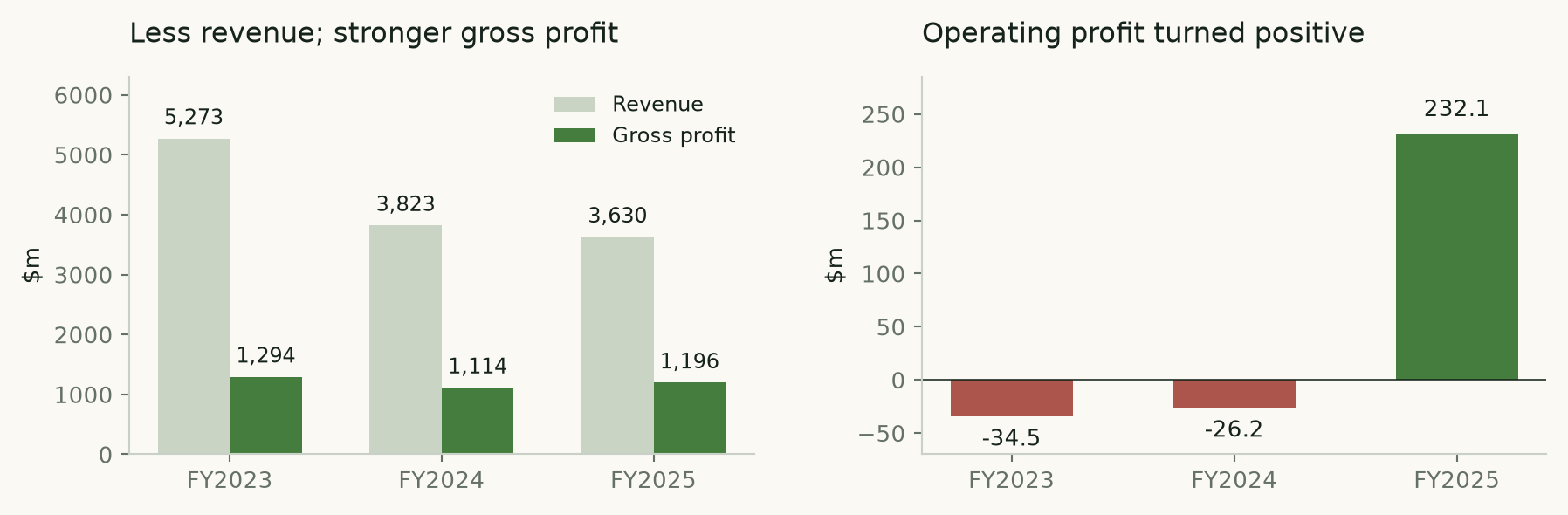
In FY2025, sales fell 5.1%, but gross-profit dollars grew 7.4%. Lower costs helped turn a $26.2m operating loss into a $232.1m operating profit. Collectibles revenue rose 47.7%. [1]
Q1 2026 adjusted operating profit reached $140.5m, against $27.5m a year earlier. But the $389.6m net-income headline also included a $268.4m eBay investment gain. That is why we separate the business from its investments instead of multiplying one quarter’s earnings by four. [2]
Management’s guidance of more than $600m in FY2026 adjusted EBITDA is encouraging. EBITDA is not operating profit or free cash flow; those measures cannot be swapped into the model interchangeably. [3]
03 / PUT A PRICE ON THE CASE
What does $19.16
already ask of GME?
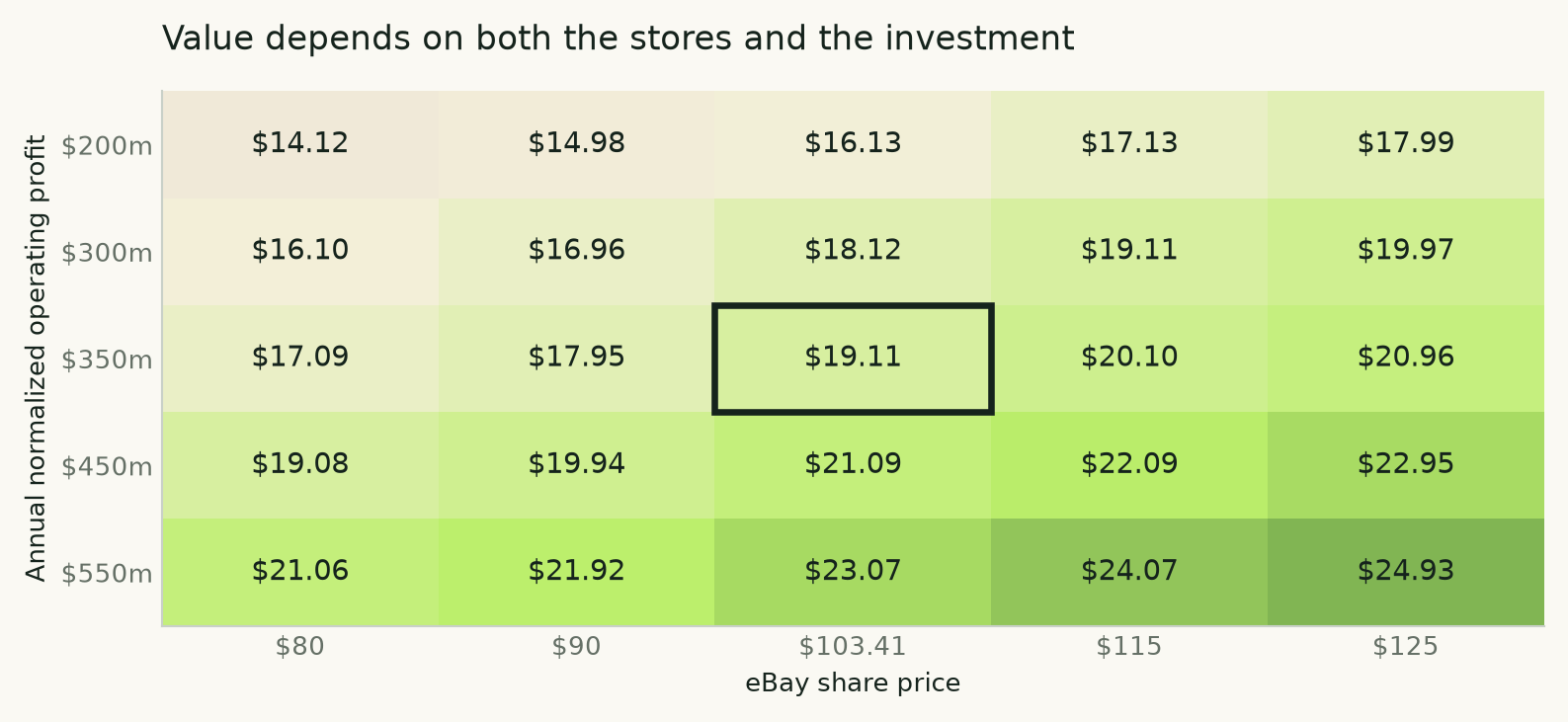
We adjust the preliminary cash balance for the announced debt exchange, mark 43.4m eBay shares at $103.41 and subtract $2.8bn of remaining note principal. That leaves about $6.39bn, or $12.67 per GME share, before our reserve and operating-business valuation. [4] [5]
This is a partial bridge, not a price floor. Cash movements, investment taxes and other claims matter. With a $250m modeling reserve and a 10× operating-profit multiple, the reference share price requires roughly $353m in sustainable annual operating profit.
(Financial assets − debt − reserve + operating profit × multiple) ÷ shares
Every $10 move in eBay changes the look-through value by approximately $0.86 per GME share, before tax and assuming the holding stays unchanged. GME investors are also making a substantial call on eBay.
| Assumption | Downside | Central | Upside |
|---|---|---|---|
| eBay price | $80 | $103.41 | $125 |
| Annual operating profit | $200m | $350m | $550m |
| Profit multiple | 8× | 10× | 12× |
| Modeling reserve | $500m | $250m | $100m |
| GME value / share | $12.83 | $19.11 | $27.41 |
| Versus $19.16 | −33% | −0.3% | +43% |
04 / WHAT WOULD CHANGE OUR MIND?
The catch is part
of the letter.
- Profits that do not repeat. Cost cuts and collectibles demand need to produce durable earnings, not one strong quarter.
- Capital allocation. A falling eBay position or a poor acquisition can undo progress in the stores.
- Dilution and the denominator. The debt exchange increased the share count. Warrants and convertibles still need monitoring.
- New results. The full Q2 filing may change cash, investment marks and the operating picture. Read this as a dated starting point.
The full letter also examines cash conversion, financing terms and the options market’s earnings pricing. A recognizable ticker does not remove those risks.
05 / WHY THIS IS ISSUE 001
Where else would
the button start?
GME and the missing buy button belong to the same memory. The next chapter is to make the research public, explain what could break the case and show the receipt if we act on it.
The idea is weekly stock research paired with rewards funded by collected creator fees. Eligible holders keep their BUY; the program allocates the selected stock tokens under its round rules. GME is the first researched pick. This dated letter is the research, not a purchase or payout receipt. The holder page shows current earning estimates and claim availability.
BUY burns are a separate mechanism that removes tokens from practical circulation. They do not guarantee a higher price, a fixed reward or a larger share of a round.
KEEP THE WORK. CHECK THE WORK.
The full letter is open.
The PDF contains the detailed analysis and 28-source ledger. The spreadsheet includes editable assumptions, valuation sensitivities and reward-allocation examples. Published by the BUY project; research and judgment, not independent investment advice or a purchase receipt.
Edition 001 · Information cutoff: 8 September 2026, 01:50 UTC. Market prices are dated reference inputs, not live quotes. Future results should be checked against the GameStop investor site.